


Montessori Preschool Curriculum for Children With Special Needs
Last Updated: November 21, 2026
Quick Summary
A montessori preschool curriculum can serve children with special needs when teachers adapt pace, materials, choice and goals to each child. Lessons stretch or shorten, tools become larger or easier to grip, and targets are set for the individual rather than the age group.
Only about 8.49% of early-childhood students in surveyed Montessori programs were children with disabilities, per a 2022 survey.
Core domains are practical life, sensorial, language, mathematics and culture, paired with short time blocks by age.
Ages 3 to 4 work in 10 to 20 minute sessions; ages 5 to 6 run longer and more abstract.
Pour water with a lighter pitcher and funnel, or spoon beans first, to keep the underlying skill intact.
Ask preschools how teachers are trained in special education and how individualized goals are tracked.
Table of Contents
How Montessori Principles Adapt for Children With Special Needs
A Preschool Curriculum Plan by Age, Domain and Daily Routine
Adapting Specific Montessori Activities for Different Support Needs
Environmental Modifications and Sensory Accommodations Checklist
Individualized Planning, Progress Monitoring and Collaboration With Specialists
How Montessori Principles Adapt for Children With Special Needs
Montessori education can work well for children with disabilities, but the method has to bend to fit each child. See what a Montessori curriculum looks like in practice for a concrete picture of the day. Only about 8.49% of early-childhood (ages 3-6) students in surveyed Montessori programs were children with disabilities, according to a 2022 survey published in the Journal of Montessori Research.
At ILIM School, we start from a simple idea: a child learns best when the environment meets them where they are. Core Montessori ideas, including child study, hands-on materials, choice, and individualized pacing, were also used in special education and early intervention, as J. Cossentino's 2010 report on early intervention and Montessori notes.
Here is what usually changes for a child with special needs:
Pace: Lessons stretch or shorten based on attention and stamina.
Materials: Tools may be larger, textured, or easier to grip.
Choice: Options are narrowed so a child is not overwhelmed.
There is no standardized Montessori curriculum for children with autism or other disabilities. Teachers adapt lessons to each child's needs, which is both the strength and the challenge of the approach.
A Preschool Curriculum Plan by Age, Domain and Daily Routine
Most Montessori preschool classrooms organize learning into five domains: practical life, sensorial, language, mathematics, and culture (which includes science, geography, art, and music), forming the core of a montessori preschool curriculum. For a child with special needs, the plan works best when each domain is paired with a realistic time block, a small set of core materials, and a clear accommodation note. The plan below is a starting template, not a script, adjust the time blocks to the child's stamina and the materials to the child's support needs.
Ages 3 to 4: short, repeated, sensory-rich
Practical life (15-20 minutes, twice daily): Spooning, pouring, transferring with tongs, opening and closing containers, hand washing, and simple food prep. These build grasp, bilateral coordination, and sequencing, the same fine-motor foundations that occupational therapists target.
Sensorial (10-15 minutes): Pink tower, brown stair, knobbed cylinders, color tablets, and sound cylinders. Start with two or three pieces and add contrast gradually.
Language (10-15 minutes): Spoken vocabulary cards, object-to-picture matching, sandpaper letters for children ready for letter sounds, and shared book time with pause-and-response prompts.
Ages 5 to 6: longer, more independent, more abstract
Practical life (20-30 minutes): Care of the environment (plant watering, table washing), food preparation with real tools, and simple grace-and-courtesy routines.
Sensorial (15 minutes): Grading and matching with less contrast, binomial cube, and geometric solids with labels.
Language (20-30 minutes): Moveable alphabet for word building, phonetic object boxes, handwriting practice, and story sequencing.
A sample daily routine
Arrival and greeting (15 minutes): Practical life tasks, hanging up a bag, signing in, pouring water.
Morning work period (45-60 minutes): Two or three domains, one-on-one or in small groups, with a visual work plan the child can check off.
Movement break (10-15 minutes): Walking on the line, balance paths, or fine-motor games.
For children who need extra support, plan on work sessions of 10 to 20 minutes and expand them as focus builds.
Watch out: A montessori preschool curriculum plan that looks balanced on paper can still fail if transitions between domains are too abrupt.
The article's age-based plan pairs each domain with a time block, so a parent or teacher can see the daily pacing at a glance.
Age group | Domain | Time block |
Ages 3 to 4 | Practical life | 15-20 minutes, twice daily |
Ages 3 to 4 | Sensorial | 10-15 minutes |
Ages 3 to 4 | Language | 10-15 minutes |
Ages 3 to 4 | Mathematics | 5-10 minutes |
Ages 5 to 6 | Practical life | 20-30 minutes |
Ages 5 to 6 | Language | 20-30 minutes |
Ages 5 to 6 | Mathematics | 15-20 minutes |
Ages 5 to 6 | Culture | 15-20 minutes |
Adapting Specific Montessori Activities for Different Support Needs
Most classic Montessori activities can be adapted without losing the learning point. The goal is to keep the cognitive or functional skill the material was designed to teach while changing how the child reaches it. The adaptations below are organized by support need so a teacher or parent can match the change to the child rather than guessing.

Language and communication needs
Sandpaper letters: Offer a raised or textured version, pair the trace with a spoken sound, and allow a picture card as a visual cue. For children using augmentative and alternative communication (AAC), add the letter or word to the device so the child can respond during the lesson.
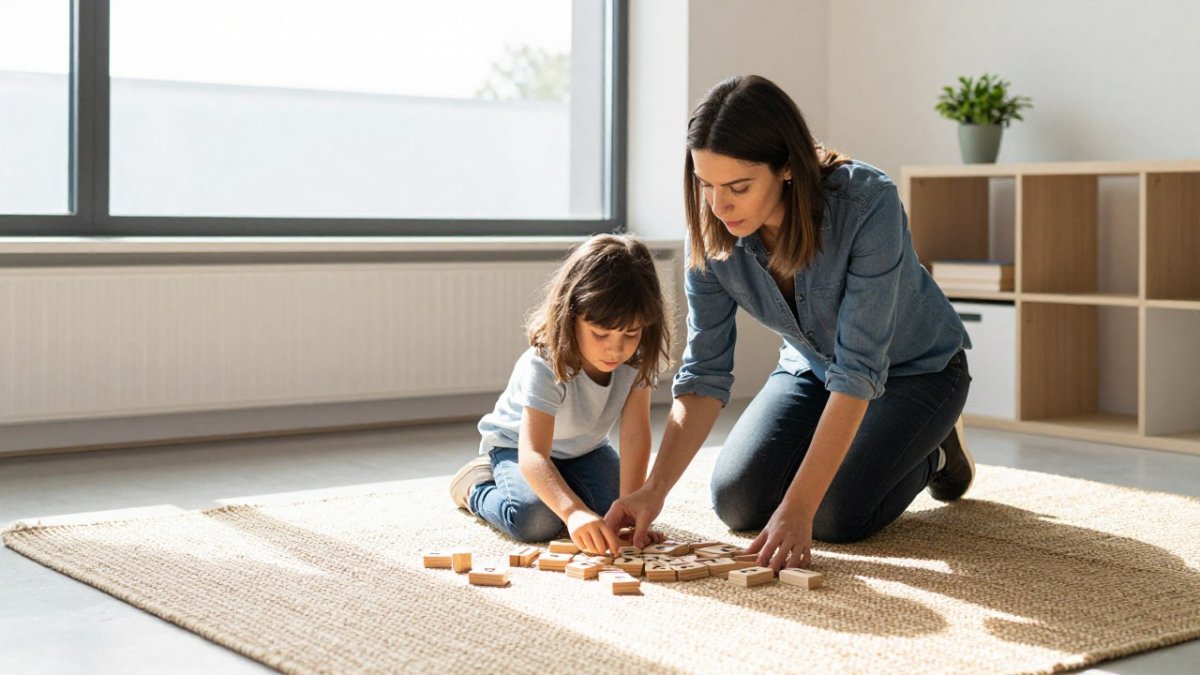
Moveable alphabet: Use larger tiles with high-contrast letters, limit the set to the letters in the child's name or current word list, and provide a word bank with pictures.
Object boxes: Replace spoken labels with picture-to-object matching first, then add the spoken word as the child is ready.
Story sequencing: Use three-card sequences instead of five, and let the child arrange them before retelling.
Motor needs (fine and gross)
Pouring activities: Use a lighter pitcher, a wider tray, and a funnel or a spouted cup. A non-slip mat under the tray reduces spills and frustration.
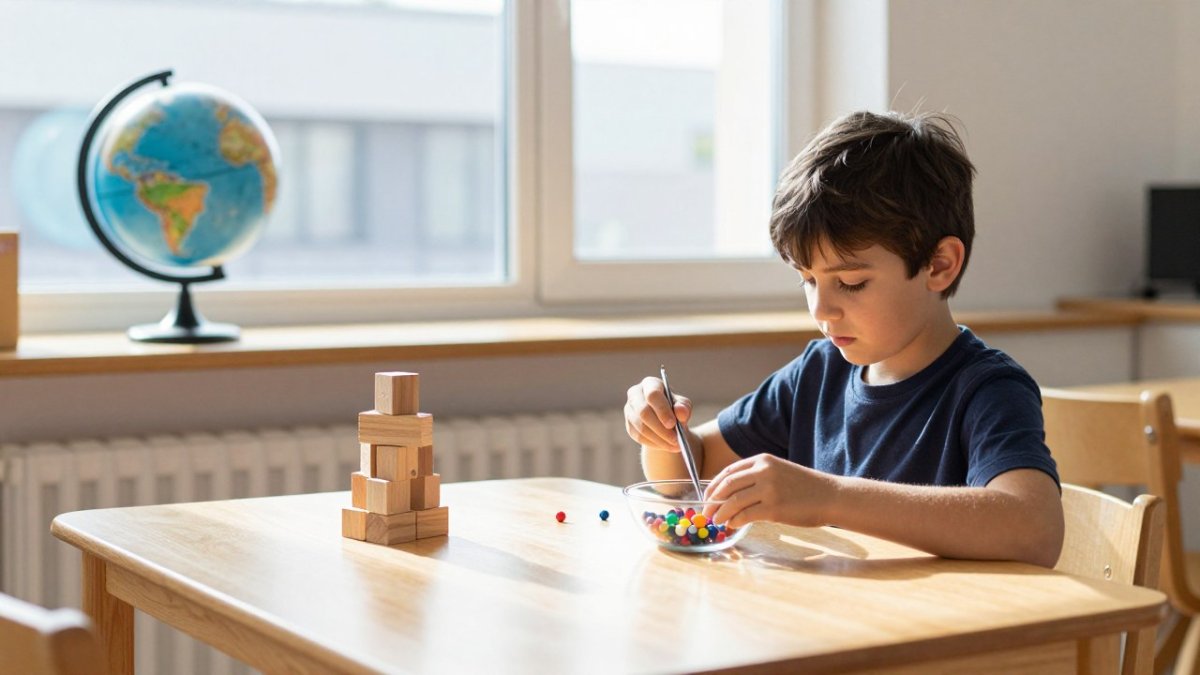
Transferring with tongs or tweezers: Start with larger objects (pom-poms, cotton balls) and a wider grip, then move to smaller objects and a pincer grip.
Cylinder blocks: Begin with two or three pieces and a single size, then add more as the child succeeds. A knobbed version is easier to grasp than a knobless one.
Walking on the line: Replace a long line with a shorter path, add a handrail or a partner's hand, and use a textured line for children who need tactile feedback.
Sensory needs
Sound cylinders: Reduce the number of pairs, start with strongly contrasting sounds, and offer noise-reducing headphones as an option rather than a requirement.
Texture tablets: Offer a glove or a finger cot for children who avoid tactile input, and pair the touch with a preferred activity.
Smelling bottles: Limit to two or three scents and keep a neutral 'rest' bottle available.
Light and movement: Replace bright overhead lighting with a lamp in the quiet corner, and allow a movement break before a seated sensorial lesson.
Attention and regulation needs
Work plans: Use a picture-based work plan with two or three choices rather than a full shelf of options. A visual timer (sand timer or countdown app) makes the end of a work period predictable.
Multi-step practical life: Break the task into a picture sequence (fill, pour, wipe, carry) and teach one step at a time before chaining them.
Circle time: Shorten to 10 minutes, seat the child near the teacher or at the edge of the group, and offer a fidget or a cushion.
Social-communication needs
Grace and courtesy lessons: Teach a single script (greeting, asking for a turn, saying 'no thank you') with role-play and picture cards before expecting it in free play.
Peer work: Pair the child with a consistent buddy for a short, structured task rather than open-ended free play.
Group games: Use turn-taking visuals (a talking stick or a turn card) and keep group size to two or three children.
Watch out: Do not drop an activity just because it looks hard on the first try. Break the task into smaller steps first, then decide whether the material itself needs changing. A child who cannot pour water may still be able to spoon beans, the underlying skill is the same, and the easier version keeps the child in the lesson rather than on the sidelines.
Environmental Modifications and Sensory Accommodations Checklist
A thoughtful classroom reduces barriers before a child has to ask for help. Use this checklist when setting up or reviewing a space:
Low, uncluttered shelves with clear picture labels
A quiet corner with soft lighting and a cushion for breaks
Noise-reducing rugs or felt on chair legs
Materials stored in clear containers the child can open
Individualized Planning, Progress Monitoring and Collaboration With Specialists
Individualized planning starts with observation. Teachers record what a child does, how long they stay with a task, and where they get stuck.
Progress should be checked on a regular schedule, often every few weeks. Look for small, measurable changes rather than broad milestones.
Strong programs also work with outside professionals. Special educators, speech therapists, and occupational therapists can share strategies that fit the classroom.
Our small class sizes at ILIM School make this kind of close watching easier. Read about the benefits of small class sizes for young leaders to see how more feedback builds confidence.
What the Evidence Shows and Where It Falls Short
The research on Montessori and disability is promising but limited. A 2022 survey gave useful counts of how many children with disabilities attend Montessori programs, but it did not measure learning outcomes. The Institute of Education Sciences evaluation of public preschool Montessori will examine academic, social, and emotional skills, but its results are not yet available.
Case studies show encouraging individual outcomes, but they are small. Treat strong claims with care, and ask programs for specifics.
Questions to Ask a Preschool Before Enrolling Your Child
Before you commit, ask direct questions:
What training do teachers have in special education?
How do you write and track individualized goals?
Who from outside the school can you work with, such as a therapist?
How do you adapt materials for a child with my child's needs?
You can start with our [primary program details | page:1] to see how the day is organized. When you are ready to see the classrooms in person, [schedule a tour with our team | page:2]. Our staff can answer these questions face to face.
Frequently Asked Questions
Is Montessori good for children with special needs?
Montessori can suit some children with special needs because its practices, including child study, manipulative materials, choice and individualized lessons, have also been used in special education and early intervention. The evidence is limited, though. Research on Montessori for children with disabilities is mostly descriptive. Montessori also does not automatically provide the specialized support every child needs. Parents should ask a program directly how it individualizes lessons, who provides therapy or special education services, and how progress is measured before deciding whether it fits their child.
Can autistic kids go to Montessori school?
Many autistic children attend Montessori programs, and some families report good results. The method's predictable routines, hands-on materials and self-paced work can appeal to children who learn best through structure and concrete tasks. There is no standardized Montessori curriculum for autism, so teachers must adapt lessons to each child's needs. Before enrolling, ask how the school handles transitions, sensory breaks and communication support, and whether teachers have training in autism or special education. A single successful case does not show that a program will work for every autistic child.
What should parents ask a Montessori preschool about special education support?
Ask whether teachers have special education training, how individualized learning plans are written and reviewed, and how often families receive progress updates. Find out whether the school works with outside speech, occupational or behavioral therapists, and whether it can accommodate a child's current services. Ask how many children each adult supports and what the school does when a child needs more one-to-one help than the classroom can provide. Request a classroom visit during a work period to see how lessons are adapted in practice.
Can a Montessori classroom support a child with sensory needs?
A Montessori classroom can support sensory needs when the prepared environment is organized with them in mind. Low shelves, defined work areas, quiet corners and a predictable daily rhythm can reduce overload for many children. Sensorial materials can be used at a child's own pace, and teachers can offer alternatives such as fidget tools, headphones or movement breaks. Parents should confirm that the school can make these accommodations in practice, not only describe them, and that staff know how to recognize and respond to sensory distress.

Comments