


What a Montessori Curriculum Looks Like in Practice
A child carefully pouring water from one small pitcher to another may not look like they are doing serious academic work. Yet that simple activity is building concentration, coordination, order, confidence, and the ability to complete a task independently. Those habits are central to a Montessori curriculum, and they shape how children approach increasingly complex learning over time.
For many Charlotte-area families, Montessori is the starting point of their school search. They want an environment where their child is known, challenged at an appropriate level, and trusted with meaningful responsibility. Understanding what the approach looks like in practice can help parents distinguish between a school that uses a few Montessori materials and one that builds its daily learning model around Montessori principles.
What Defines a Montessori Curriculum?
A Montessori curriculum is a connected approach to learning rather than a packaged set of lessons or a fixed pace every child must follow. It was developed from the observation that children learn deeply when they can make purposeful choices, work with their hands, repeat activities until they feel satisfied, and learn within a prepared environment designed for their stage of development.
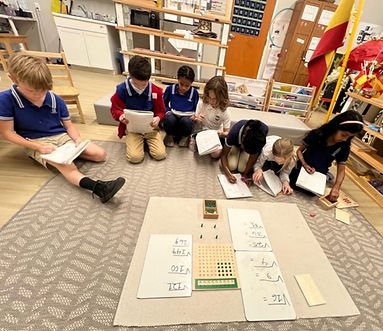
The classroom is organized so children can independently reach materials, select work, return it when finished, and care for the shared space. Teachers guide, observe, introduce new concepts, and help each child move forward. They do not simply stand at the front of the room delivering the same lesson to every student at the same moment.
This does not mean children are left to do whatever they want. Freedom in Montessori classrooms exists within clear expectations. Children learn how to choose productive work, respect others' concentration, use materials responsibly, solve everyday problems, and contribute to their community. The structure is thoughtful, but it is not one-size-fits-all.
Learning Through Purposeful Work
Montessori classrooms often include carefully designed, hands-on materials that make abstract ideas visible. A young child may use beads to explore quantity and the decimal system long before memorizing an equation on paper. An elementary student may build a timeline, research a civilization, write a report, and present their findings to classmates.
The purpose is not to make learning look like play at all times. It is to give children concrete experiences that lead to real understanding. When a child can see, touch, compare, sort, build, and explain an idea, they are more likely to understand why it works instead of simply remembering an answer for a test.
Practical life work is equally important in the early years. Preparing a snack, buttoning a frame, cleaning a table, arranging flowers, or caring for classroom materials develop fine motor control and independence. Just as significantly, these activities tell children that their contributions matter. A capable child is more willing to attempt hard things.
The major areas of study
In early childhood, the curriculum commonly includes practical life, sensory learning, language, mathematics, and cultural studies. These areas overlap naturally. A child strengthening hand control through practical life activities is also preparing for writing. A child sorting objects by size or color is building the foundations for mathematical thinking.
As children grow, the academic scope expands. Elementary Montessori learning includes reading, writing, mathematics, science, geography, history, art, and research. Students are encouraged to ask larger questions: How do systems work? Why do communities make different choices? What connects events across time and place?
This broader view matters because education should prepare children for more than completing assignments. It should prepare them to communicate clearly, think critically, work with people who see the world differently, and make responsible decisions.
Why Mixed-Age Classrooms Matter
One of the clearest differences families notice is the mixed-age classroom. Montessori programs typically group children across a multi-year span rather than separating every child by a single birth year.
This arrangement gives younger students accessible role models. They can observe how older children organize work, use materials, and manage more advanced projects. Older students reinforce their own knowledge by explaining concepts, offering help appropriately, and taking on leadership within the classroom.
A mixed-age setting also gives teachers more room to honor different learning rates. A child who is ready to advance in one area does not need to wait for an entire class to catch up. A child who needs additional practice can receive it without being labeled or separated from peers. The goal is steady growth, not racing through content.
That said, mixed-age grouping is not automatically individualized learning. It works well when teachers know each student, keep clear academic records, and plan lessons with intention. Families should ask how a school tracks progress and ensures children receive both support and challenge.
The Teacher's Role Is Active, Not Passive
A common misunderstanding is that Montessori teachers simply watch while children teach themselves. Observation is an essential skill, but it is only one part of the work. Effective Montessori teachers prepare the environment, give precise lessons, notice when a child is ready for a new challenge, protect focused work time, and step in when guidance is needed.
They also help children develop social judgment. In a classroom community, students learn to enter another child's work respectfully, express disagreement, repair mistakes, and participate in shared responsibilities. These are leadership skills, not extras to be addressed only after academics are finished.
The best learning moments are often quiet. A teacher may give one child a short math lesson while another writes, a small group researches an animal habitat, and a younger student repeats a practical life activity nearby. This requires a classroom culture where concentration is valued and children understand what productive independence looks like.
Assessment Looks Different, but Progress Still Matters
Parents reasonably want to know how their child is progressing. Montessori education does not eliminate assessment. It changes the emphasis from frequent comparison and test preparation to close observation, demonstrated mastery, work samples, conferences, and academic records.
A strong program can explain what children are learning, where they are succeeding, and what comes next. Teachers should be able to communicate clearly about literacy development, mathematical understanding, writing, executive-function skills, and social growth. Older students may also complete assessments that help schools measure progress and prepare students for future academic transitions.
The trade-off is that this approach asks families to look beyond a single score. A report card can be useful, but it cannot fully show whether a child persists through a difficult task, revises their work after feedback, collaborates with peers, or speaks confidently about what they have learned. Those abilities shape long-term success.
Montessori and Multilingual, Global Learning
Montessori's cultural curriculum creates a natural foundation for global learning. Children study geography, people, ecosystems, history, and traditions as connected parts of the human story. This can help them develop curiosity instead of treating other cultures as isolated topics or occasional celebrations.
Language learning can deepen that work. When children learn to communicate in more than one language, they gain more than vocabulary. They practice listening closely, recognizing different perspectives, and engaging with cultures respectfully. For globally connected families, that experience can be especially meaningful. For every child, it strengthens communication and cultural awareness.
At ILIM School, we build on Montessori principles with multilingual learning and a focus on the skills international leaders need: adaptability, thoughtful communication, collaboration, and confident decision-making. The aim is not to make children grow up too quickly. It is to give them repeated opportunities to become capable participants in a diverse world.
Questions Families Should Ask
The word Montessori is used broadly, so parents should look beyond the label. Ask how long uninterrupted work periods last, how teachers individualize instruction, and whether children use hands-on materials as part of a coherent progression rather than as occasional classroom activities.
It is also helpful to ask about teacher preparation, classroom age groupings, communication with families, and how the school supports transitions into later grades. Observe if possible. Are children engaged in meaningful work? Can they explain what they are doing? Does the classroom feel calm and purposeful rather than overly controlled or chaotic?
No educational model is right for every family in exactly the same way. Some children thrive immediately with choice and independent work, while others need time and patient guidance to build those habits. What matters is whether the school offers enough structure, expertise, and partnership to help each child grow.
When parents visit a classroom, they do not need to search for a perfect display of quiet behavior. Look instead for something more valuable: children who are trusted with real work, supported by capable adults, and gradually learning that their choices, effort, and contributions have weight.


Comments