


Is Four Languages Too Much? The Truth About Multilingual Education UNESCO Doesn't Want You Ignoring
Every parent who learns about four-language education asks the same question: "Won't that overwhelm my child?"
It's the most natural concern in the world. We've been conditioned to believe that adding more languages means adding more stress, more homework, more confusion. But here's what decades of research reveals: and what traditional education systems rarely acknowledge: your child's brain isn't just capable of learning multiple languages simultaneously; it's actually designed for it.
The real question isn't whether four languages is too much. It's whether we're giving our children enough.
The Multilingual Brain: Built for More Than We Think
Children aren't miniature adults learning languages the way we do: through memorization, translation, and struggle. Their brains operate fundamentally differently during the critical language acquisition period.

Before age eight, children process languages through the same neural pathways they use for their first language. They don't translate; they simply absorb. They don't memorize grammar rules; they internalize patterns naturally. This isn't theory: it's neuroscience.
Consider this: a child growing up in Switzerland might hear German at home, French at school, Italian with grandparents, and English in media: and they navigate all four without confusion. Why? Because their developing brain doesn't categorize languages as separate subjects to be studied. It treats them as different tools for communication.
The "overload" myth exists because adults project their own language-learning difficulties onto children. We struggle with second languages because we're using the wrong part of our brain: the part designed for conscious learning rather than unconscious acquisition.
The Window of Opportunity Nobody Talks About
Here's what traditional education gets wrong: timing matters more than method.
UNESCO's research on multilingual education emphasizes starting with the mother tongue and gradually introducing additional languages: and they're absolutely right about the foundation. But what often gets lost in translation is that this structured approach works best when started early and maintained consistently throughout the critical developmental years.
The window for native-like pronunciation closes around age seven. The window for grammatical intuition closes around puberty. The window for developing true multilingual fluency: where you think and dream in multiple languages: narrows significantly after eighth grade.
This isn't about pressure. It's about opportunity.
What Happens During This Window
Between PreK and 8th grade, children's brains are:
Building foundational neural pathways that determine how easily they'll acquire additional languages throughout life
Developing phonemic awareness across multiple sound systems simultaneously
Creating flexible cognitive structures that allow for code-switching without conscious effort
Establishing cultural frameworks that shape how they understand and interact with the world
Wait until high school, and you're teaching languages as academic subjects. Start during the critical years, and you're building multilingual minds.

Why Arabic, Mandarin, Spanish, and English Matter
Most language programs offer the comfortable choices: Spanish and French. Maybe Mandarin if the school wants to appear innovative. But here's the strategic reality: language selection isn't just about culture; it's about global positioning.
Coverage
These four languages provide access to 75% of the global population. That's not just a statistic: it's a network effect.
English remains the lingua franca of business, science, and technology
Mandarin opens doors to the world's largest economy and fastest-growing markets
Spanish connects three continents and 500 million native speakers
Arabic unlocks 22 countries, critical geopolitical regions, and centuries of scientific and philosophical tradition
Future-Proofing
By 2050, Spanish will be the first language of 10% of the world's population. Mandarin already dominates global manufacturing and innovation. Arabic-speaking regions represent some of the fastest-growing economies. These aren't random selections: they're strategic investments in your child's future relevance.
Cognitive Diversity
Here's where it gets fascinating: these languages represent fundamentally different linguistic structures.
English and Spanish share Latin roots and similar sentence structures
Mandarin operates with tonal variations and character-based writing
Arabic flows right-to-left with an entirely different grammatical framework
Learning languages from different families doesn't just teach vocabulary: it rewires how children process information, recognize patterns, and solve problems.
Beyond Vocabulary: What Multilingual Children Really Gain
The conversation about multilingual education often stops at "speaking multiple languages." That's like saying the value of piano lessons is "knowing where the keys are."
The real transformation happens in how multilingual children think.

Executive Function Enhancement
Research consistently demonstrates that children learning multiple languages simultaneously develop:
Superior attention control: the ability to focus on relevant information while filtering distractions
Enhanced working memory: holding and manipulating multiple pieces of information simultaneously
Improved cognitive flexibility: switching between different tasks and mental frameworks effortlessly
Advanced problem-solving skills: approaching challenges from multiple perspectives
These aren't language skills. These are life skills.
Cultural Intelligence
In Mozambique's bilingual education programs, students didn't just perform 15% higher in academics: they developed deeper contextual understanding and personal connection to learning. When children learn languages, they don't just learn words; they learn worldviews.
A child who speaks Arabic understands hospitality differently. A child who speaks Mandarin thinks about time and relationships differently. A child who speaks Spanish experiences family and community differently.
This isn't cultural appropriation: it's cultural fluency. And in an increasingly interconnected world, cultural intelligence might be more valuable than any technical skill.
Communication Confidence
Multilingual children develop something educators call communicative competence: the confidence to engage across barriers, adapt to different contexts, and connect with diverse audiences.
This shows up as:
Willingness to take risks in new social situations
Comfort with ambiguity when meaning isn't immediately clear
Natural code-switching ability that transfers to professional settings
Empathy for non-native speakers in any language
These children don't just learn to speak: they learn to truly communicate.
How ILIM Makes Four Languages Natural, Not Overwhelming
Here's where method meets mission. Teaching four languages poorly is worse than teaching one language well. The question isn't just whether to teach multiple languages: it's how to do it in a way that feels natural rather than forced.
Collaborative Guides, Not Traditional Teachers
At ILIM, we don't have teachers lecturing in four languages. We have collaborative guides who facilitate language acquisition the way it happens naturally: through interaction, play, discovery, and meaningful context.
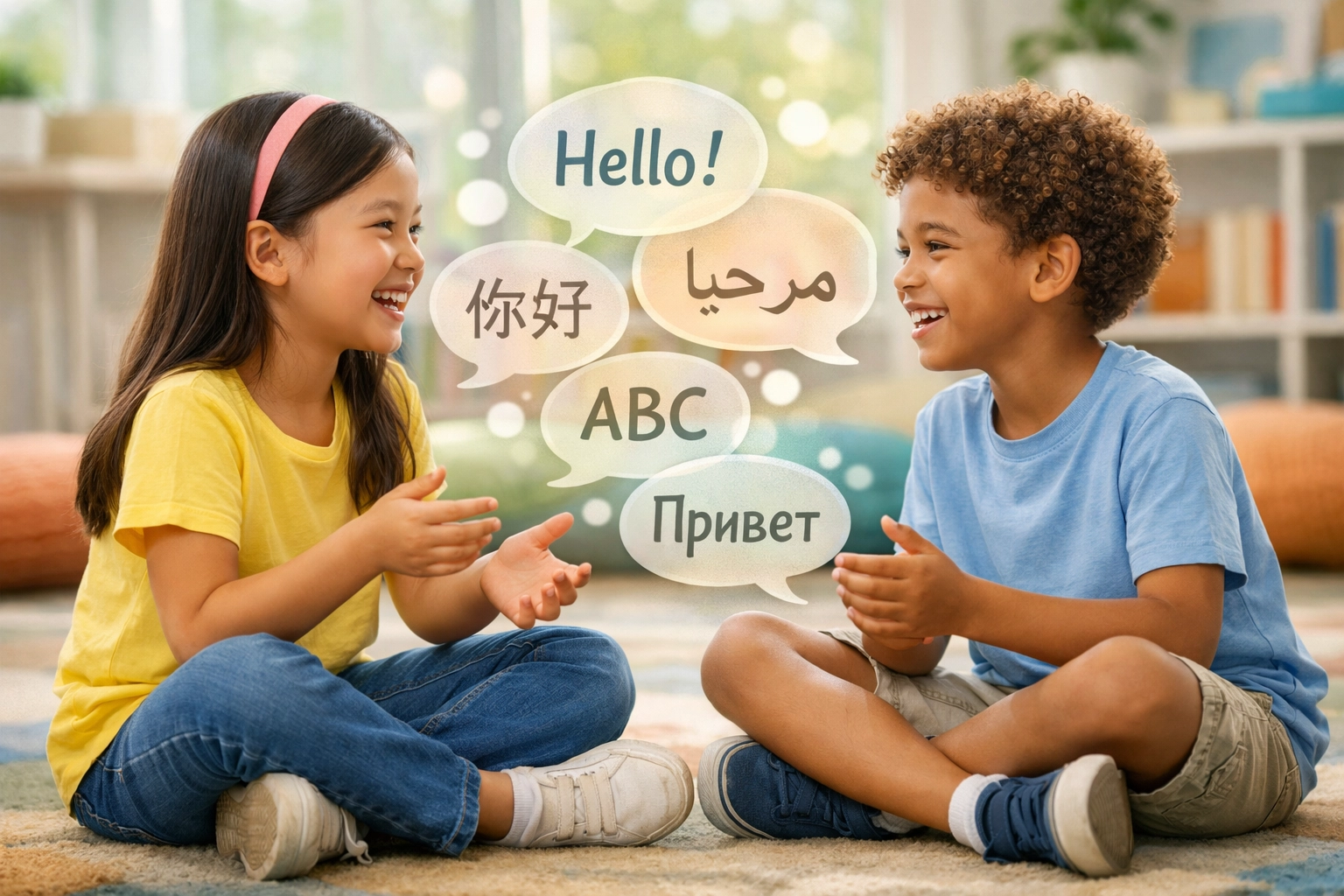
Children don't sit through Spanish class, then Mandarin class, then Arabic class. They engage with projects, activities, and experiences where different languages emerge organically based on context and need.
AI-Powered Personalization
Every child's language journey is unique. Some might show early affinity for tonal languages. Others might gravitate toward Latin-based structures first. Our AI-enhanced approach tracks individual progress and adjusts exposure to ensure each child builds confidence while being appropriately challenged.
This isn't about AI replacing human connection: it's about technology enabling more personalized, responsive human guidance.
Integration, Not Isolation
Languages aren't taught as separate subjects. They're woven into math, science, art, music, and social studies. A child might explore geometry using Mandarin vocabulary, discuss history in Arabic, present scientific findings in Spanish, and collaborate on creative projects in English: all in the same week.
This mirrors how multilingual families actually live. Languages aren't compartmentalized; they're tools used based on context and purpose.
The Question Isn't "Is It Too Much?": It's "What Are We Waiting For?"
The concern that four languages might overwhelm a child comes from a place of love and protection. But protecting children from opportunity isn't the same as protecting them from harm.
Every parent wants their child to have options, advantages, and the ability to navigate an increasingly complex world with confidence. Multilingual education doesn't just open doors: it removes the locks entirely.
The research is clear. The window is limited. The benefits extend far beyond language itself.
Your child's brain is ready. The real question is: are we giving them the chance?
Ready to see how multilingual education works in practice? Schedule a call with our education team at ILIM School and discover how we make four-language fluency natural, engaging, and transformative. .


Comments